Weather & Clima - Weather Sky
- 4.4
- Rating
- 1.00M
- Installs
- Free
- Price

 Analysis by App-foxy
I spend enough time checking the sky before leaving home that a weather app has to do more than show a temperature. I want a quick answer for the next hour, a useful view of the day ahead, and enough detail to decide whether I need a jacket, an umbrella, or a change of plans. Weather & Clima - Weather Sky, developed by The Weather App Company, is built around that everyday need. It is a free weather app for everyone, with optional in-app purchases ranging from $0.99 to $24.99 per item.
After using it as a regular weather companion, I found it most appealing for people who want a straightforward forecast without turning weather checking into a research project. It also suits users who like keeping conditions visible through a weather widget rather than opening an app every time. My overall impression is positive, but it is not automatically the best choice for every kind of weather watcher. Its value depends on whether you prefer a clean daily routine or highly specialized meteorological tools.
How Weather Sky feels in everyday use
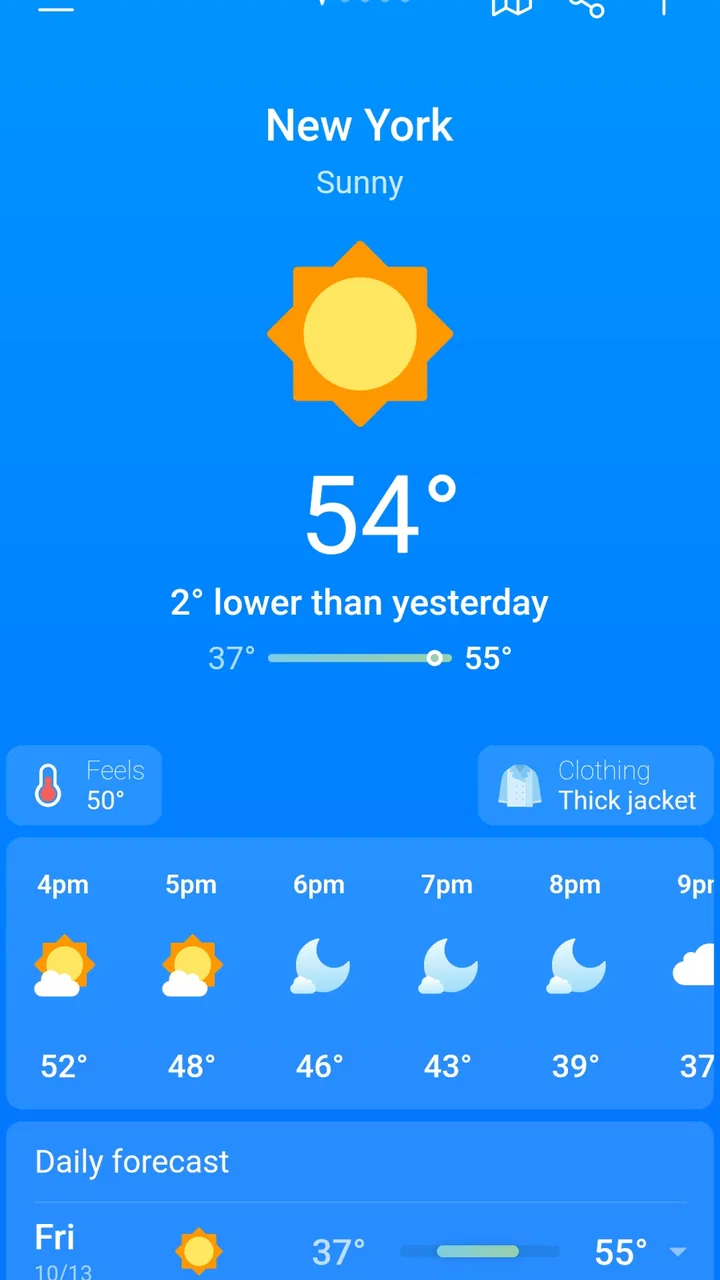
The app presents itself as “Weather Sky,” and that simple identity matches the experience. I can use it for the basic questions that come up throughout the day: Is it going to rain soon? Will the temperature drop later? Is the morning commute likely to be comfortable? The broad focus is practical rather than intimidating, which makes it easy to recommend to someone who does not want a screen crowded with technical charts.
You May Also Like

 Blood Strike: 2.5 Anniversary
Blood Strike’s Loadouts Turn Every Drop Into a Tactical Gamble
A close look at Blood Strike’s custom loadouts: how fast access to signature weapons reshapes its battle royale rhythm, rewards preparation, and narrows the gap between fights.

 Pandora - Music & Podcasts
Pandora’s Music Is Easy to Start, but Harder to Recover
Pandora’s strength is its low-effort path from a seed to a station. Its weak spot is how much confidence it asks you to place in connection, setup, and quiet recovery.

 8 Ball Pool
 Is Built on Rivalries, Rematches, and Routine
A close look at the rivalries, rematches, shared routines, and unanswered safety questions that turn a quick pool match into a persistent mobile community.

 Samsung Music
’s Quiet Strength Is Playing What You Already Own
Its reach comes less from spectacle than from dependable access to a personal library. That simplicity is both the app’s strongest retention engine and its ceiling.

 AccuWeather: Weather Radar
AccuWeather Review: A Quick, Clear Forecast for Everyday Decisions
For everyday plans, the best forecast is the one you can understand quickly. AccuWeather makes rain timing, radar, and local conditions easy to act on, with a few trade-offs.

 Hill Climb Racing
Why Hill Climb Racing Still Turns Crashes Into One More Run
A tiny car, a bumpy hill and one more upgrade: Hill Climb Racing keeps resurfacing because its simple chaos makes every near-miss feel personal.
More From Our News Desk



Its weather category positioning is clear, but the app also connects naturally with familiar sources and concepts such as the national weather service and NOAA. That matters to users who are cautious about relying on an attractive forecast without thinking about where the information comes from. I would still treat any forecast as guidance rather than a promise, especially when conditions are changing quickly, but the app’s focus makes it suitable for routine planning.
The strongest part of the experience is the quick-check habit. I can look at the current conditions, scan the upcoming outlook, and make a decision without spending several minutes interpreting unfamiliar symbols. That is especially useful when the phone is being used one-handed while getting ready for work or school. The app does not need to become the center of my day; it works best as a small, repeatable tool.
The widget angle is also important. A widget can change how often I use a weather app because it removes the extra step of opening it. For example, before walking the dog, I can glance at the home screen and decide whether a light coat is enough. For someone who checks the weather only once every few days, that convenience may not matter much. For commuters, parents, cyclists, gardeners, and anyone working outdoors, it can make the forecast feel more integrated into daily routines.
A practical morning routine
A realistic way to use Weather Sky is to check it twice rather than repeatedly refreshing it. In the morning, I would look at the current conditions and the day’s direction before choosing clothes or planning travel. Later, shortly before leaving, I would check again if rain or strong temperature changes are likely to affect the trip. This avoids treating a forecast as fixed while still keeping the routine quick.
That second check is a useful trade-off. Weather apps can encourage false confidence when a forecast is read hours before an event. Weather Sky is more helpful when I use it as a decision aid close to the time I actually need the information. If I were organizing a long outdoor event, I would compare its outlook with a more specialized source and keep checking as the event approaches.
Another useful habit is to compare the forecast with what is happening outside instead of blindly following a single number. A temperature can feel different depending on wind, cloud cover, humidity, and whether I am standing in direct sun. The app is convenient for the first answer, but my own observation still matters. That is not a flaw unique to this product; it is simply the sensible way to use a consumer forecast.
What the current release tells me
The current version is 4.13.30, and the app was released on Aug 12, 2019. Those details suggest a product with a longer history than a brand-new weather utility, which is useful when judging whether it has had time to settle into a consistent role. I do not read the version number alone as proof of quality, but it does show that the app has continued along a defined product path rather than appearing as a one-off experiment.
For existing users, a current release like this is most meaningful when it preserves the simple actions they already depend on: opening the forecast, checking conditions, and using the widget without having to relearn the whole interface. I would pay attention to whether updates make the app faster and clearer or gradually add clutter. Weather software benefits from refinement more than from endless visual changes.
The minimum operating system is Android 7.1, which gives the app a relatively broad reach among Android users with older devices. That can be valuable if someone wants a weather tool without replacing a still-functional phone. At the same time, people using very old hardware should judge the experience by responsiveness and widget behavior on their own device. A compatible operating system does not guarantee that every phone will feel equally quick.
The app has reached over one million installs and holds a 4.5 average from around thirty-four thousand ratings. I see that as a reassuring sign of broad interest, not as a reason to ignore personal preferences. A large user base can indicate that the basic experience works for many people, while still leaving room for individual complaints about layout, forecasts, advertising, or optional purchases.
There are also 195 written reviews, which means the numerical rating is supported by a smaller body of detailed public discussion than the rating count might first suggest. I would use the score as a general signal and then test the app in my own location. Weather accuracy can vary by region, and the usefulness of a widget depends heavily on how a person organizes the phone’s home screen.
Where it is stronger than the usual alternatives
Compared with checking a browser search every time, a dedicated app is more convenient because the forecast has a persistent place on the phone. The widget makes that difference even clearer: I can see weather information without opening a tab, dismissing a pop-up, or typing a location. For quick decisions, that is a real advantage rather than a cosmetic one.
Compared with official weather-service apps, Weather Sky may feel less specialized and more approachable. An official source can be preferable when I need formal warnings, detailed regional information, or a direct connection to severe-weather guidance. Weather Sky is better suited to the ordinary questions that fill most days. I would use the former for high-stakes weather awareness and the latter for a fast personal forecast, depending on what is available in my region.
Compared with highly technical weather apps, it is likely to be easier for casual users to understand. A detailed radar or aviation-oriented tool can be excellent for enthusiasts, pilots, sailors, storm watchers, and outdoor professionals, but that level of information can slow down a simple decision. If my only concern is whether to carry an umbrella on the way to lunch, a less crowded experience is more useful.
The trade-off is that simplicity can become a limitation. Users who want deep radar analysis, extended historical comparisons, specialized alerts, or professional planning tools should not choose an app merely because it has a pleasant everyday presentation. Weather Sky makes more sense as a practical companion than as a complete meteorological workstation.
Small workflows that make it more useful
One of my preferred workflows is to place the widget where I naturally look before leaving home, rather than hiding it on a secondary screen. The point is not to make the phone busier; it is to turn weather checking into a glance. If the widget becomes visually distracting, I would rather reduce how often I look at it than allow it to dominate the home screen.
A second workflow is to use the app before committing to weather-sensitive errands. If I am deciding whether to cycle, dry clothes outside, walk with a child, or schedule gardening, I check the near-term outlook first and then consider how costly a wrong decision would be. For a low-consequence choice, a quick glance is enough. For a long trip or outdoor appointment, I would compare information and leave room for changing conditions.
A third insight is to separate “current conditions” from “planning information.” Current conditions answer what is happening now; they do not necessarily answer what will happen when I arrive somewhere later. I find the app most reliable as part of a two-stage routine: check the present situation, then inspect the later period that actually matters. That simple distinction prevents one of the most common mistakes people make with weather apps.
I would also avoid judging the app after only one unusual day. Forecast performance can feel disappointing during rapidly shifting weather, but a single result does not explain whether the issue came from local conditions, timing, or the limits of prediction itself. Testing it across ordinary mornings, commutes, and weekend plans gives a fairer sense of whether its presentation works for me.
What may frustrate some users
The free model makes the app easy to try, but optional in-app purchases mean that some parts of the experience may involve spending. The available items range from $0.99 to $24.99 each. I would look carefully at what an optional purchase changes before paying, especially if I already have another weather app that covers my essential needs.
That pricing range creates an important distinction between “free to install” and “free enough for my routine.” A person who only wants a basic forecast and widget may be satisfied without buying anything. Someone who wants every convenience or enhancement should decide whether the added value is worth the cost over time. I would not pay simply to unlock information I can obtain more clearly elsewhere.
The Everyone content rating makes the app suitable for a broad audience, including households looking for a simple weather tool. That does not mean every user will enjoy the same interface. Children may appreciate the visual simplicity, while weather enthusiasts may find it too restrained. Older users may value the quick glance, but could still prefer a larger display or a less busy widget depending on their phone.
Another possible friction point is reliance on a single app for important weather decisions. I would not use Weather Sky as my only source when severe weather, travel safety, outdoor work, or emergency preparation is involved. A general forecast app can support awareness, but official alerts and local guidance should take priority when the consequences are serious.
Who should install it, and who should skip it
I would recommend Weather Sky to someone who wants a free starting point, a clear weather routine, and a useful widget on an Android phone. It is especially suitable for people who check conditions before commuting, walking, exercising, shopping, or planning simple outdoor activities. The broad age rating and support for Android 7.1 also make it a practical candidate for family members using older devices.
I would be more cautious about recommending it to a weather hobbyist who expects advanced analysis. If radar layers, storm tracking, specialized alerts, or detailed technical data are central to the decision, a dedicated specialist app or official service may be a better fit. The same applies to professionals whose work depends on precise, location-specific forecasting rather than a convenient daily overview.
I would also suggest skipping it if the phone is already crowded with weather tools and the existing setup works well. Installing another app only makes sense when its widget, presentation, or routine is more convenient than what is already available. The fact that it has over one million installs does not remove the need to compare it with the tools already on the device.
What I would watch as the app evolves
For future updates, I would watch whether the developer keeps the balance between useful detail and quick readability. A weather app can lose its appeal if every release adds more panels, prompts, or distractions. The best evolution would preserve the fast glance while making the information easier to interpret when conditions change.
I would also pay attention to how the widget develops. A widget should remain dependable, readable, and genuinely helpful from the home screen. If it becomes too small to interpret or too crowded to scan, its main advantage weakens. Existing users should notice whether updates improve the everyday workflow rather than merely changing the appearance.
The other area worth watching is the relationship between the free experience and the optional purchases. A free app earns trust when the basic weather routine remains useful without pressure to buy. Paid additions can be reasonable, but I would expect them to feel like clear extras rather than barriers placed around ordinary forecast checking.
Finally, I would keep an eye on compatibility as Android devices continue to change. Supporting Android 7.1 helps older phones, but long-term usefulness also depends on how comfortably the app behaves across newer screens and current device habits. The ideal path is broad compatibility without making the interface feel dated or overloaded.
My final take
Weather & Clima - Weather Sky is at its best when I treat it as a calm, everyday weather check rather than a full professional forecasting system. The free entry point, widget-focused convenience, broad age rating, and familiar weather-service orientation give it a sensible place on an Android phone. I like that it can support small decisions without demanding much attention.
Its limitations are just as important to understand. Optional purchases may not suit everyone, and users who need deep analysis or high-stakes weather information should look beyond a general-purpose app. I would use it for clothing, commuting, errands, exercise, and ordinary outdoor plans, then consult a more authoritative or specialized source when safety or precision matters more.
With a 4.5 average from around thirty-four thousand ratings, the app has earned enough attention to justify a personal trial. My recommendation is simple: install it if you want a convenient forecast and widget on an older or newer Android phone, use it for practical planning, and judge it by how naturally it fits your routine. If your weather needs are technical, professional, or warning-focused, choose a more specialized alternative instead.
FAQs for Weather & Clima - Weather Sky
01What features does Weather & Clima - Weather Sky offer?
Weather & Clima - Weather Sky provides real-time weather updates, detailed forecasts, radar maps, and alerts for severe weather conditions. The app also includes features such as sunrise and sunset times, air quality indices, and customizable widgets for your home screen. Users can also access historical weather data.
02Is Weather & Clima - Weather Sky available for both Android and iOS?
Yes, Weather & Clima - Weather Sky is available for both Android and iOS devices. You can easily download it from the Google Play Store for Android or the Apple App Store for iOS. Ensure your device meets the minimum system requirements for optimal performance.
03Does Weather & Clima - Weather Sky require an internet connection to function?
While Weather & Clima - Weather Sky provides the most accurate and up-to-date information with an internet connection, some features like previously downloaded forecasts and alerts may still be accessible offline. However, for real-time updates and radar maps, an active internet connection is necessary.
04Are there any in-app purchases or subscriptions in Weather & Clima - Weather Sky?
Weather & Clima - Weather Sky offers a free version with basic features. However, for an ad-free experience and access to premium features like detailed radar maps and extended forecasts, users may opt for in-app purchases or a subscription plan. Pricing details are available within the app.
05How accurate is the weather data provided by Weather & Clima - Weather Sky?
Weather & Clima - Weather Sky sources its data from reliable meteorological services, ensuring high accuracy and reliability. The app is designed to update frequently, providing users with the latest weather conditions. User feedback and regular updates further improve the app’s accuracy and performance.
Pros
- Accurate weather forecasts
- User-friendly interface
- Customizable alerts
- Rich visual graphics
- No intrusive ads
Cons
- Limited free version features
- Occasional location inaccuracies
- Battery consumption is high
- Requires constant internet
- Ads in free version

Weather & Clima - Weather Sky
Gallery